Why Ducks Are Nature's Tiny Geniuses (And What They're Teaching Your Kids Without Anyone Realizing It)
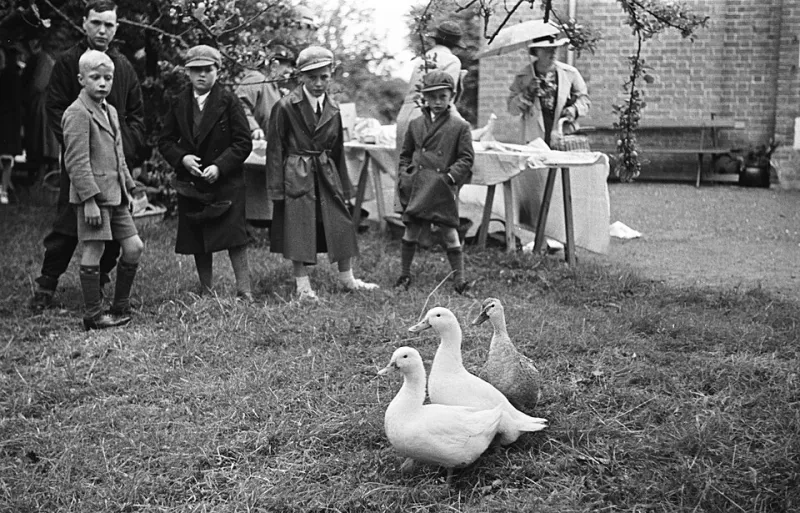
Photo: Geoff Charles, CC BY-SA 4.0, via Wikimedia Commons
Let's be honest: when most of us think about ducks, we picture a wobbly little bird begging for bread at the park (which, by the way, please don't feed them bread — more on that in a second). But here at Ducky Channel, we've always suspected there's way more going on behind those shiny little eyes. Turns out, science agrees with us. Ducks are remarkable problem-solvers, and studying their behavior is one of the most sneaky-effective ways to get kids genuinely excited about science, technology, engineering, and math.
So grab your binoculars, your curiosity, and maybe a rain jacket, because we're diving beak-first into the surprisingly brilliant world of duck behavior.
Tiny Navigators: How Ducks Are Better at Directions Than Most Adults
Every fall, millions of ducks across North America pack their metaphorical bags and head south. Mallards, teal, wood ducks, and dozens of other species fly hundreds — sometimes thousands — of miles along established routes called flyways. The Mississippi Flyway alone sees over 40 percent of North American migratory waterfowl pass through each year. And they do all of this without GPS, Google Maps, or a single wrong turn into a Walmart parking lot.
How? Ducks use a combination of magnetic field detection, star patterns, landmark recognition, and even smell. Scientists believe ducks have magnetite crystals in their beaks that essentially function like a biological compass. That's not a cartoon superpower — that's real, peer-reviewed science.
Try this at home: Challenge your kids to navigate from one room to another using only a hand-drawn map they made themselves. Then level it up by doing it blindfolded with only verbal directions from a sibling. Ask them afterward: What other information would have helped you? What do you think ducks use when the sky is cloudy? You've just introduced the concept of redundant systems in engineering — something NASA engineers think about every single day.
The Social Network: Duck Flocks and What They Reveal About Teamwork
Ducks are not loners. They travel in groups, communicate constantly, and make collective decisions about when to fly, where to feed, and when danger is near. Female mallards are famously vocal — that classic quack-quack-quack you hear at the pond? That's almost always a hen, not a drake. Male ducks actually make a much quieter, raspier sound. The females use their calls to keep the group together, signal alarm, and even establish social status.
Research from the University of Oxford found that ducklings can understand abstract relational concepts — like "same" and "different" — within hours of hatching. Hours! That's a level of cognitive flexibility that puts them in surprisingly elite company in the animal kingdom.
Connect it to STEM: Social organization in duck flocks mirrors concepts in computer science like distributed networks and swarm intelligence. No single duck is "in charge" in the way a CEO might be. Instead, information spreads through the group and decisions emerge collectively. This is the same logic behind how the internet routes data, how ant colonies build tunnels, and how traffic algorithms reduce congestion on highways.
Ask your kid: If no one duck is the boss, how does the whole flock decide to fly away at the same time? Watch their brain start working. That's systems thinking, and it's a foundational skill for any future engineer, biologist, or even urban planner.
Waterproofing 101: A Chemistry Lesson You Didn't Know You Needed
Here's a question that stumps a surprising number of adults: Why don't ducks get soaked? They spend half their lives in water, yet their feathers stay dry and they never seem cold or waterlogged. The answer is preen oil — a waxy substance produced by a gland near the duck's tail, which they spread across their feathers using their beak. This oil creates a hydrophobic (water-repelling) surface, causing water to bead up and roll off rather than soak in.
This is literally the same principle behind Gore-Tex jackets, waterproof phone cases, and the lotus-effect coatings used on everything from car windshields to hospital surfaces.
Backyard experiment: Pour water onto a regular piece of paper, then rub a candle (or a little petroleum jelly) on another piece of paper and pour water on that one. Watch how the coated paper repels water just like duck feathers. Boom — you've just demonstrated hydrophobic chemistry with supplies from your kitchen drawer.
Ducks in Animated Media: More Educational Than You'd Think
At Ducky Channel, we love a good animated duck as much as anyone. But here's something worth noting for parents: the best duck-themed animated content doesn't just entertain — it subtly reinforces the real behavioral traits that make ducks so fascinating. When animated ducks migrate, form friendships, or adapt to new environments, kids are absorbing accurate frameworks for understanding animal behavior, even if the ducks are also, say, wearing tiny hats.
Use those moments as launchpads. After watching a nature-themed episode together, ask: Do real ducks do that? Let's find out. A two-minute YouTube search or a trip to a local wildlife refuge can turn a cartoon into a genuine learning adventure.
Don't Feed Them Bread (Seriously, Though)
We promised we'd come back to this. Bread is nutritionally empty for ducks and can actually cause a developmental condition called "angel wing" in young birds, where wings grow improperly due to poor diet. If you're visiting a local pond with your kids, bring cracked corn, oats, or defrosted frozen peas instead. It's a small change that teaches children a powerful lesson: caring about animals means learning what they actually need, not just what's convenient for us.
That's environmental awareness in action. And environmental awareness, it turns out, starts with a duck.
The Takeaway (Quack Edition)
Ducks are not background scenery at the park. They are living, breathing demonstrations of biology, physics, chemistry, mathematics, and social science. Every time a child stops to watch a duck — really watch — they're practicing observation, the single most important skill in all of science.
So next time you're near a pond, a creek, or even just watching your favorite Ducky Channel programming, slow down. Ask questions. Let the ducks do the teaching for a while. They've been at it for about 65 million years, so they've probably got the hang of it.